
Around 2,500 years ago, a dynasty from the highlands of southern Iran built the largest empire the world had ever seen. The Achaemenid Empire, also called the First Persian Empire, stretched from the Balkans and Egypt in the west to the Indus Valley in the east. It lasted about 220 years, from 550 to 330 BCE, and left ideas about government, roads, art and tolerance that still shape our world.
Here is the story of the Achaemenids: how they rose, how they ruled, and what they left behind.
Achaemenid Empire at a Glance
- Dates: c. 550 to 330 BCE
- Founder: Cyrus the Great
- Capitals: Pasargadae, Susa, Persepolis, Babylon and Ecbatana (Hamadan)
- Languages: Old Persian, Elamite, Babylonian and Aramaic for administration
- Greatest extent: about 5.5 million square kilometers under Darius I
- End: conquered by Alexander the Great in 330 BCE
The Rise: Cyrus the Great
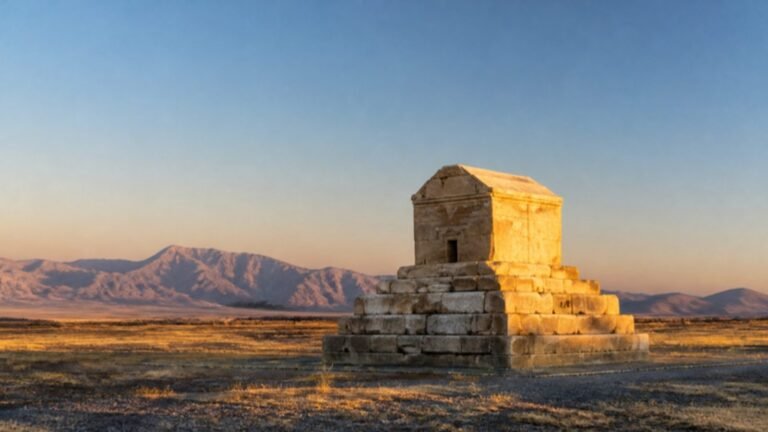
The empire was founded by Cyrus II, a king of the Persians from Anshan in today’s Fars province. Around 550 BCE he united the Persians and the Medes. He went on to conquer Lydia in Anatolia and, in 539 BCE, the city of Babylon. Cyrus became famous for letting conquered peoples keep their customs and religions, a policy recorded on the Cyrus Cylinder. You can read his full story in our article on Cyrus the Great Day. He was buried at Pasargadae, the scene of our Tomb of Cyrus Hoodie.
Cambyses II and the Conquest of Egypt
Cyrus’s son, Cambyses II, extended the empire to Egypt in 525 BCE. For the first time, one state ruled the great river civilizations of the Nile, the Tigris and the Euphrates at once.
Darius the Great: The Empire Builder
Darius I (ruled 522 to 486 BCE) turned a vast set of conquests into an organized state. Many of the empire’s most lasting achievements date from his reign.
Satrapies
Darius divided the empire into provinces called satrapies, each led by a governor, or satrap. Royal inspectors known as “the eyes and ears of the king” traveled the provinces to check on them. This system allowed one king to govern dozens of peoples speaking many languages.
The Royal Road
The Royal Road ran about 2,700 km from Sardis in Anatolia to Susa in Iran. Relay stations with fresh horses allowed royal messengers to cover the route in about a week, a journey that took travelers on foot around three months. It was one of the first great postal systems in history.
Coins, canals and the Behistun inscription
Darius introduced the gold daric, one of the first widely used coins. He completed a canal linking the Nile to the Red Sea, a distant forerunner of the Suez Canal. His story is carved high on a cliff at Behistun in Kermanshah province in three languages, an inscription that later helped scholars decipher cuneiform. It appears on our Kermanshah T-Shirt.
Persepolis and the Art of the Empire
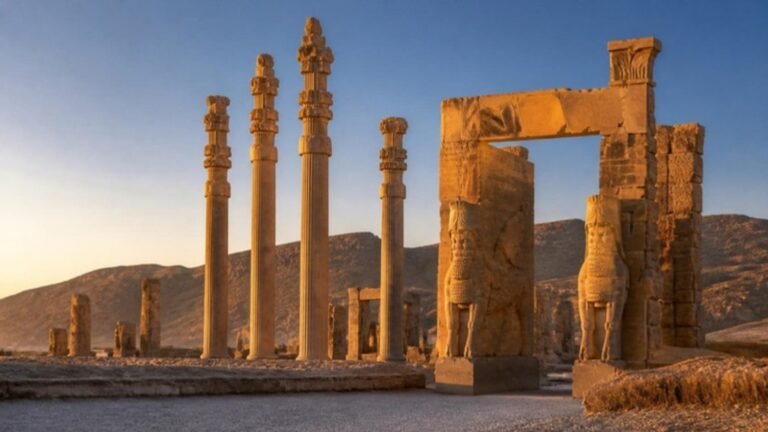
Darius began building Persepolis around 518 BCE as a ceremonial capital. Its great halls, columns and reliefs show delegations from across the empire bringing gifts to the king, a picture of many nations living under one roof. Read more in our guide to the history of Persepolis, or see the guardians of its entrance on our Gate of All Nations Hoodie. Persepolis also inspired our Fars T-Shirt.
The older city of Susa, in today’s Khuzestan province, served as the administrative capital. Its palace was decorated with famous glazed brick friezes of archers, now displayed at the Louvre. Susa features on our Khuzestan T-Shirt.
Religion and Tolerance
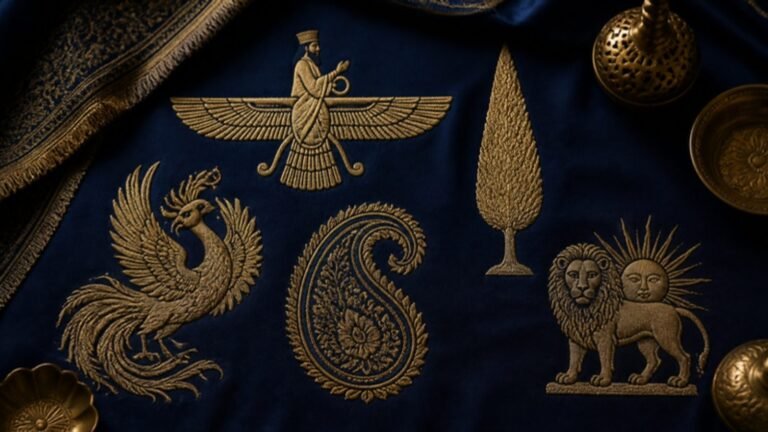
The Achaemenid kings honored Ahura Mazda, the supreme god of Zoroastrian tradition, and the winged figure known today as the Faravahar appears on their monuments. At the same time, they generally allowed their subjects to follow their own beliefs. The Hebrew Bible praises Cyrus for letting Jewish exiles return to Jerusalem, and Persian kings supported temples in Babylon and Egypt.
Xerxes and the Wars with Greece
Darius and his son Xerxes I led campaigns against the Greek city-states. The Greeks won famous victories at Marathon in 490 BCE and at Salamis in 480 BCE. These wars shaped how the Greeks, and later Europe, saw Persia. For the Persians, Greece was a distant frontier of a much larger empire.
The Fall of the Empire
In 334 BCE, Alexander the Great of Macedon invaded the empire. After his victory over Darius III at Gaugamela in 331 BCE, he took Babylon, Susa and Persepolis, where the palaces burned in 330 BCE. Darius III was killed by one of his own nobles the same year, ending the Achaemenid dynasty. Yet Alexander adopted many Persian customs and kept much of the Persian system of government.
The Legacy of the Achaemenids
- A model of empire: provinces, governors, roads and a postal service that later empires copied.
- Tolerance: respect for local religions and customs as a way to rule diverse peoples.
- Art and architecture: Persepolis blended styles from across the empire into something new.
- Engineering: qanats, canals and roads, described in our article on ancient Persian inventions.
- Identity: for Iranians today, the Achaemenids are a source of pride and a reminder of how old their culture is.
Timeline of the Achaemenid Empire
- c. 550 BCE: Cyrus the Great unites the Medes and Persians.
- 539 BCE: Cyrus enters Babylon.
- 525 BCE: Cambyses II conquers Egypt.
- 522 BCE: Darius I becomes king.
- c. 518 BCE: Construction of Persepolis begins.
- 490 BCE: Battle of Marathon.
- 480 BCE: Xerxes invades Greece; battles of Thermopylae and Salamis.
- 331 BCE: Alexander defeats Darius III at Gaugamela.
- 330 BCE: Persepolis burns and the dynasty ends.
Frequently Asked Questions
How long did the Achaemenid Empire last?
About 220 years, from around 550 BCE, when Cyrus the Great founded it, to 330 BCE, when Alexander the Great conquered it.
What was the capital of the Achaemenid Empire?
The empire had several capitals. Pasargadae was founded by Cyrus, Susa was the main administrative center, Persepolis was the ceremonial capital, and Babylon and Ecbatana were also royal residences.
How big was the Achaemenid Empire?
At its height under Darius I it covered about 5.5 million square kilometers, from the Balkans and Egypt to the Indus Valley.
Who was the most famous Achaemenid king?
Cyrus the Great, the founder, and Darius the Great, who organized the empire and began Persepolis, are the best known.