Iran’s deserts and mountains are not easy places to live. To survive and thrive there, Persian engineers, doctors and scholars developed ideas so clever that many are still used today. Here are ten ancient Persian inventions and discoveries that changed the world, and the places in Iran where you can still see them.
1. The Qanat: Underground Rivers in the Desert
A qanat is a gently sloping underground tunnel that carries water from a mountain aquifer to the surface many kilometers away, without pumps. Because the water flows below ground, it does not evaporate in the desert heat. Persians were building qanats nearly 3,000 years ago, and the technique spread from Iran to North Africa, Spain and even the Americas. The Qanat of Gonabad in Khorasan is believed to be about 2,700 years old and still supplies water. In 2016, UNESCO listed eleven qanats as the World Heritage Site “The Persian Qanat.”
2. The Yakhchal: Ice in the Middle of the Desert
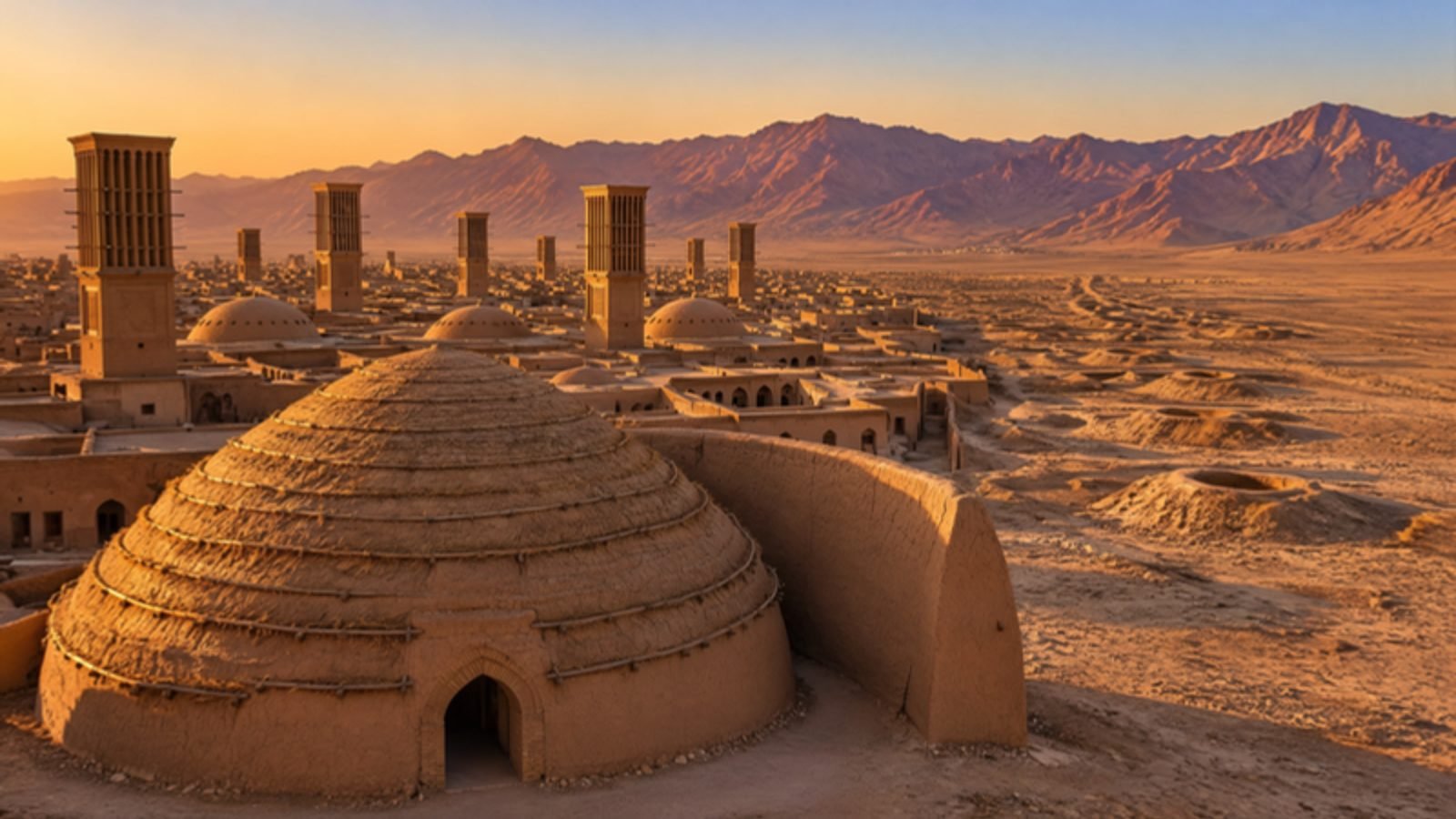
By around 400 BCE, Persians had worked out how to make and store ice in the desert. A yakhchal, meaning “ice pit,” is a tall, cone-shaped mud-brick dome built over a deep underground chamber. In winter, water froze in shallow pools beside a shading wall, and the ice was cut and stored inside, where it could last through the summer. Historic ice houses still stand in Yazd, Kerman and Kashan. Kerman’s sights are featured on our Kerman T-Shirt.
3. The Windcatcher (Badgir): Natural Air Conditioning
The skyline of Yazd is crowned with windcatchers, tall towers that capture passing breezes and send cool air down into the rooms below, while warm air escapes upward. Combined with pools and underground channels, they cooled homes without any electricity. The windcatcher of Dowlatabad Garden in Yazd, about 33 meters tall, is one of the tallest in the world. It appears on our Yazd T-Shirt.
4. Windmills
Some of the earliest known windmills were built in eastern Iran, in the windy Sistan region. Unlike European windmills, they turn around a vertical axis behind tall mud walls. In the village of Nashtifan in Khorasan, a row of these windmills, some believed to be about 1,000 years old, still grinds grain today. Khorasan’s heritage is celebrated on our Khorasan Razavi T-Shirt.
5. The Royal Road and the Postal System
Under Darius the Great, the Persians built the Royal Road, about 2,700 km long, with relay stations where messengers could change horses. Known as chapar, this system carried royal messages across the empire in about a week. The Greek historian Herodotus admired the riders, who he said were stopped by neither snow nor rain nor heat, words that later became an unofficial motto of the United States Postal Service. Learn more about the empire behind it in our article on the Achaemenid Empire.
6. One of the World’s Oldest Board Games
At Shahr-e Sukhteh, the “Burnt City” in Sistan and Baluchestan, archaeologists found a game board with playing pieces and dice from about 5,000 years ago. It is among the oldest known board games in the world and is often described as an early ancestor of backgammon, called nard in Persian. The Burnt City is featured on our Sistan and Baluchestan T-Shirt.
7. Algebra and the Algorithm
The Persian scholar Muhammad ibn Musa al-Khwarizmi (c. 780 to 850), from the region of Khwarazm, wrote a book on solving equations whose title gave us the word algebra. The Latin form of his own name became the word algorithm, the basis of every computer program today. His work also helped spread the decimal number system to Europe.
8. Medicine: Razi and Avicenna
The physician Zakariya al-Razi (865 to 925), born in Rey near Tehran, was one of the first doctors to clearly describe the difference between smallpox and measles. A century later, Avicenna (Ibn Sina, 980 to 1037) wrote The Canon of Medicine, which was used as a medical textbook in European universities for centuries. His tomb stands in Hamadan.
9. Gondishapur: An Early Teaching Hospital
Under the Sasanian kings, the city of Gondishapur in Khuzestan became a famous center of learning. Its academy brought together Persian, Greek and Indian knowledge, and its hospital trained physicians who later shaped medicine across the Islamic world. Many historians see it as one of the earliest teaching hospitals.
10. The Shushtar Hydraulic System
In Shushtar, also in Khuzestan, an ingenious system of dams, tunnels, canals and water mills diverted the Karun River to irrigate farmland and power mills. UNESCO traces its origins to the time of Darius the Great and listed it as a World Heritage Site in 2009, calling it a masterpiece of creative genius. It appears on our Khuzestan T-Shirt.
A Culture of Ingenuity
From underground rivers to the words “algebra” and “algorithm,” Persian ideas have traveled far beyond Iran. They show a culture that met hard conditions with creativity, and that same spirit runs through Persian art, poetry and design. Explore more of that heritage in our guides to Iran’s 31 provinces and ancient Persian symbols, or find your province in the Provinces of Iran collection.
Frequently Asked Questions
What did ancient Persia invent?
Ancient Persians developed the qanat irrigation system, the yakhchal ice house, the windcatcher and early vertical windmills, and built one of the first long-distance postal systems along the Royal Road.
Did Persians invent backgammon?
One of the oldest known board games, found at the 5,000-year-old Burnt City in southeastern Iran, is often described as an early ancestor of backgammon. Backgammon, called nard, has been played in Iran for many centuries.
Is algebra a Persian invention?
The word algebra comes from the title of a book by the Persian mathematician al-Khwarizmi, who wrote one of the first systematic works on solving equations. Mathematicians from many cultures contributed to the field before and after him.
What is a qanat?
A qanat is an underground channel that brings groundwater from the foot of mountains to villages and fields by gravity alone. Qanats have been used in Iran for nearly 3,000 years.