Long before flags and logos, the people of Iran told their stories through symbols. A winged figure carved in stone, a bird that nests on the highest mountain, a teardrop pattern woven into silk: each one carries centuries of meaning. Many of these ancient Persian symbols are still part of everyday life for Iranians today, from wedding spreads to jewelry and clothing.
Here are ten of the most important symbols of Persian heritage, what they mean and where you can still see them.
1. Faravahar: The Winged Symbol of Good Deeds
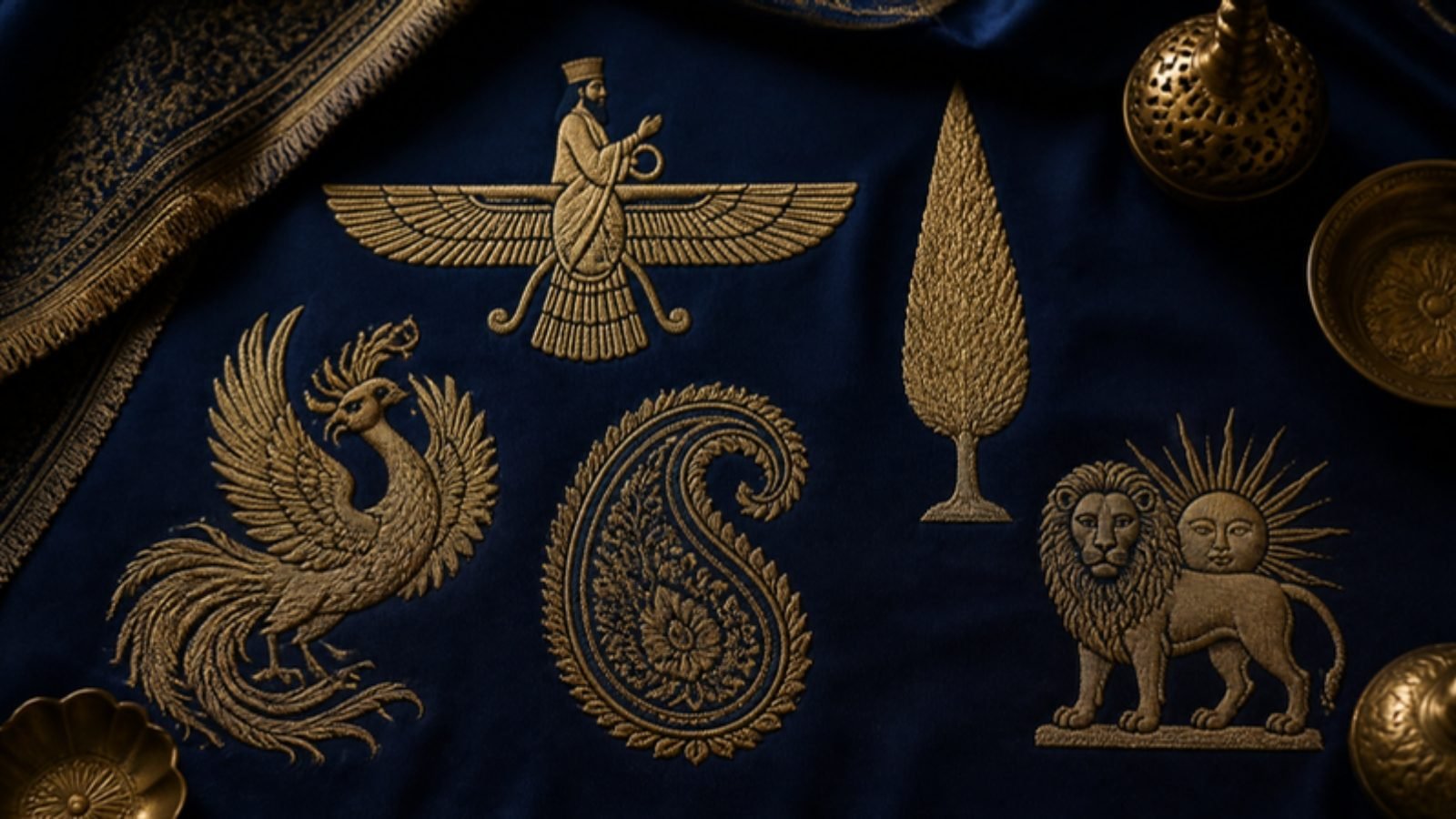
The Faravahar is probably the best-known Persian symbol in the world. It shows a bearded figure rising from a winged disc, with two long feathered wings and a tail. Versions of it appear on Achaemenid royal reliefs at Persepolis and on the rock tombs of the Persian kings.
Scholars still debate what the figure originally represented. Today it is closely linked with Zoroastrianism and is widely read as a guide for living well. The three rows of feathers on each wing are often explained as the three Zoroastrian principles: good thoughts, good words and good deeds (Humata, Hukhta, Hvarshta). The figure’s raised hand points upward, toward progress, while the ring in his other hand stands for loyalty and promises kept.
2. The Lion and Sun (Shir-o-Khorshid)
For centuries, the Lion and Sun was Iran’s national emblem. It brings together the lion, a symbol of courage and strength, and the sun, which stands for light, kingship and the ancient Persian reverence for the sky. The motif appears on coins, banners and tiles across many dynasties.
For many Iranians abroad, it remains the most powerful symbol of their national identity and culture. We tell its full story in our article on the history and meaning of the Lion and Sun.
3. Simurgh: The Wise Bird of the Alborz
The Simurgh is the great mythical bird of Persian literature. In Ferdowsi’s Shahnameh, the Book of Kings, the Simurgh lives on the peaks of the Alborz mountains and raises the abandoned infant Zal, who grows up to be the father of the hero Rostam. She later returns to heal Rostam with her magical feathers.
In the 12th-century poem The Conference of the Birds by Attar, thirty birds travel in search of the Simurgh, only to discover that they themselves are the Simurgh. The name plays on the Persian words si morgh, “thirty birds.” The Simurgh therefore stands for wisdom, healing and the idea that what we search for is already within us. She is the heart of our Simurgh Hoodie.
4. Homa: The Bird of Good Fortune
The Homa (or Huma) is a legendary bird of happiness. Persian tradition says that if its shadow falls on you, good fortune will follow, and in older stories it was said to choose kings. Its image is linked to the great griffin-shaped column capitals of Persepolis. Today the name Homa appears everywhere in Iran, from girls’ names to the logo of Iran Air.
5. The Winged Bulls of the Gate of All Nations
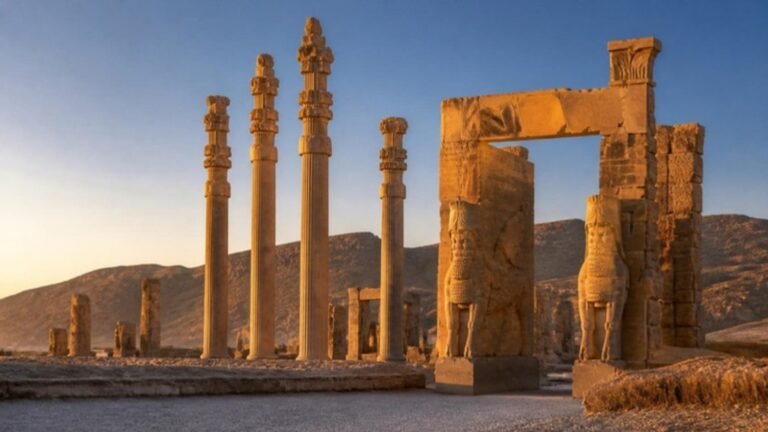
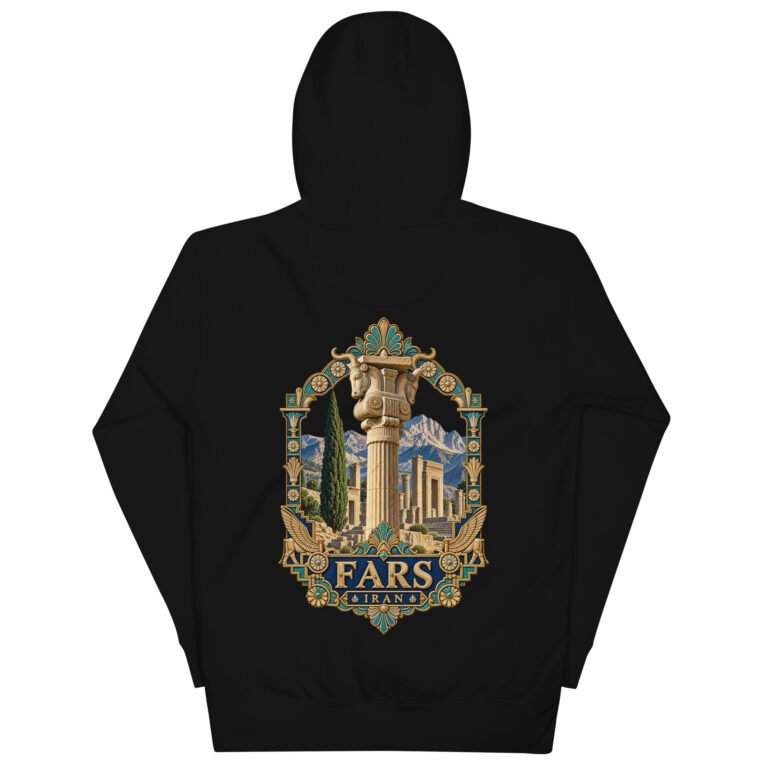
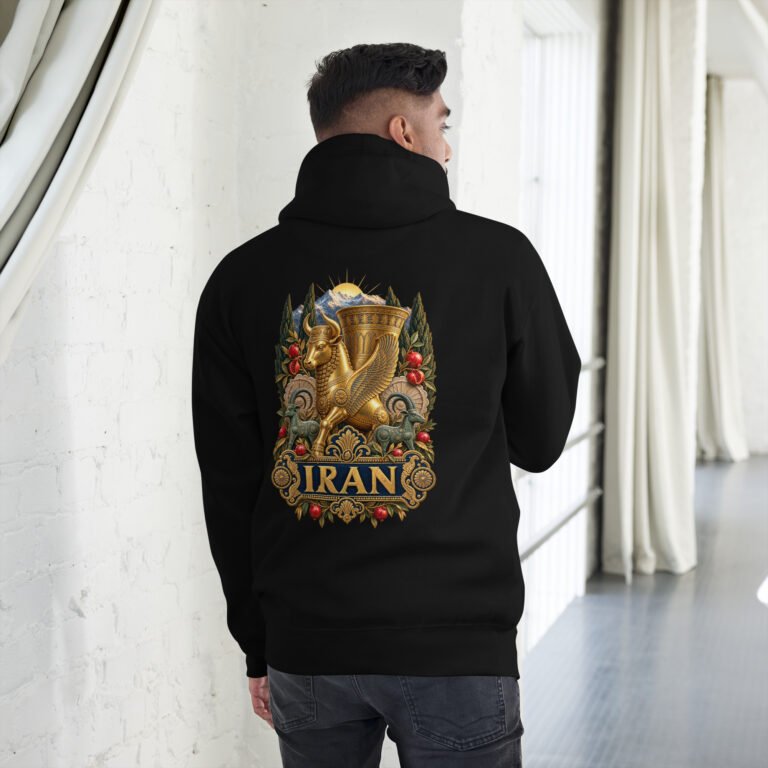
At the entrance to Persepolis, the Gate of All Nations is guarded by colossal stone bulls, two with human heads and wings. The Achaemenids adapted these protective guardians, known as lamassu, from Assyrian art and made them their own. They symbolize strength, protection and the welcome Persia offered to delegations from every corner of the empire. They appear on our Gate of All Nations Hoodie, and you can learn more about the site in our guide to the history of Persepolis.
6. The Lion and Bull Relief
One of the most repeated scenes at Persepolis shows a lion attacking a bull. Its exact meaning is uncertain. One popular interpretation links it to the spring equinox and Nowruz: the lion stands for the sun and the coming of spring, while the bull stands for the departing winter. Whatever its original purpose, it has become a lasting image of renewal and power.
7. The Cypress Tree (Sarv)
Tall, straight and green in every season, the cypress has been a Persian symbol of freedom, dignity and eternal life for thousands of years. Poets compare a beloved’s graceful posture to a cypress, and the tree appears on Persepolis reliefs and countless carpets. The ancient Cypress of Abarkuh in Yazd province is believed to be one of the oldest living trees in the world, estimated by many to be around 4,000 years old.
8. Boteh: The Persian Origin of Paisley
The boteh, a curved teardrop with a bent tip, is one of the most recognizable patterns in the world. Most people know it as “paisley,” after the Scottish town that mass-produced it in the 19th century, but the design comes from Persia. It appears on termeh textiles, carpets and embroidery. Many explain it as a stylized cypress bending in the wind or a flame, a symbol of life and eternity.
9. The Pomegranate (Anar)
With its hundreds of red seeds, the pomegranate has stood for fertility, abundance and life in Persian culture since ancient times. It is a must on the table at Yalda Night, where its red color echoes the dawn and the return of the sun after the longest night of the year.
10. The Persian Garden: The Original Paradise
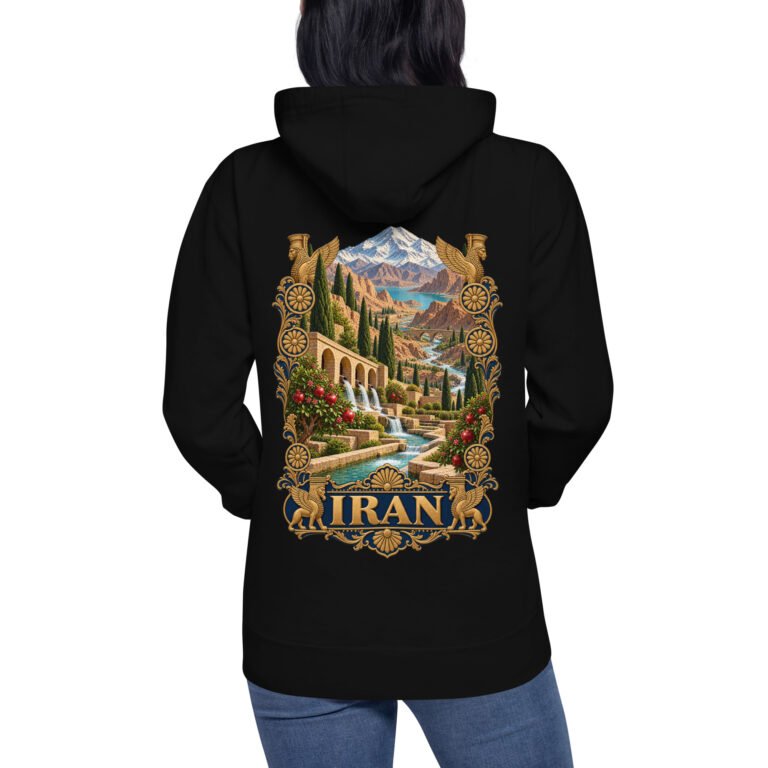
The English word paradise comes from the Old Persian pairidaeza, meaning “walled garden.” The classic Persian garden, or chahar bagh, is divided into four parts by flowing water channels, a design meant to represent harmony and an ideal world on earth. Nine historic Persian gardens are listed together by UNESCO as a World Heritage Site. Our Persian Garden Hoodie is inspired by this idea of paradise.
Wearing Your Heritage
These symbols have survived empires, invasions and revolutions because they speak to values people never stopped caring about: courage, wisdom, renewal and hope. For Iranians living around the world, wearing them is a simple way to keep those values close and to start conversations about where they come from.
Explore designs inspired by these symbols in our Spirit of Iran collection, or find the landmarks of your family’s home in the Provinces of Iran collection. Looking for a meaningful present? Our Persian gift ideas guide can help, and our article on Cyrus the Great Day tells the story of the king who started it all.
Frequently Asked Questions
What is the most famous ancient Persian symbol?
The Faravahar is the most widely recognized ancient Persian symbol, followed closely by the Lion and Sun, which served as Iran’s national emblem for centuries.
What does the Faravahar mean?
Today it is commonly explained as a guide to living well, with its three rows of feathers representing good thoughts, good words and good deeds. Its original meaning in Achaemenid art is still debated by historians.
What does the Simurgh symbolize?
The Simurgh symbolizes wisdom, healing and protection. In Persian mysticism, it also represents the divine truth that seekers discover within themselves.
Is paisley Persian?
Yes. The paisley pattern comes from the Persian boteh motif. It became known as paisley after the Scottish town of Paisley began producing shawls with the design in the 19th century.
Learn more about one of these symbols in Shir-o-Khorshid: The Lion and Sun in Persian history, and discover what else Persia gave the world in 10 ancient Persian inventions.