
Few images say “Iran” as clearly as the Shir-o-Khorshid, the Lion and Sun. For roughly eight centuries this emblem has traveled across coins, palace tiles, royal medals, flags and humanitarian badges, and today it is worn with pride by Iranians all over the world. In our earlier article we explored what the Lion and Sun means. Here we follow the symbol through Persian art and history to the places you can still find it today.
Where the Lion and Sun Comes From
The pairing of a lion and a sun began in the sky. In ancient and medieval astrology, the sun was said to be at home in the constellation of Leo, the lion. Astronomers in Babylon, Greece and later the Islamic world recorded this relationship, and artists began to draw it: a lion with the sun rising over its back.
Over time the image moved from astrology books into everyday art. It became a sign of power, light and good fortune, and eventually one of the most recognizable emblems of Iran.
1. Medieval Coins
Some of the earliest dated examples of the lion and sun appear on coins from the 13th century. A well-known silver coin issued around 1240 by Kaykhusraw II, a Seljuk sultan of Anatolia, shows a striding lion with a radiant sun above it. Coins like this show how the motif spread across the Persian-speaking world, where Persian was the language of culture and the court.
2. Ceramics, Metalwork and Tiles
From the Ilkhanid and Timurid periods onward, potters, metalworkers and tile makers used the lion and sun as a decorative theme. Under the Safavids, who ruled Iran from 1501 to 1736, it became one of the most popular images in Persian art. You can find it painted on ceramic tiles, engraved on brass bowls and woven into textiles, often with the sun drawn as a smiling human face.
3. Qajar Palaces and Buildings
During the Qajar era (1789 to 1925), the Lion and Sun appeared everywhere: above palace gates, on tiled facades, on official seals and on government buildings. Visitors to historic buildings in Tehran, Shiraz and Isfahan can still spot colorful tile panels featuring the emblem. The sights of the capital are celebrated on our Tehran T-Shirt.
4. The Order of the Lion and Sun
In 1808, Fath-Ali Shah Qajar created the Order of the Lion and Sun, a royal decoration awarded to distinguished foreigners and, later, to Iranians. Diplomats, officers and scholars from Europe and Asia received its star-shaped medal, which helped make the emblem known far beyond Iran’s borders. Original medals are now prized by museums and collectors.
5. Iran’s Flag for More Than a Century
The Lion and Sun appeared on Iranian flags from the early 19th century. The Supplementary Fundamental Laws of 1907, part of Iran’s first constitution, officially described the national flag as green, white and red with the Lion and Sun at its center. It remained Iran’s national emblem until 1979, which is why many Iranians in the diaspora still see it as the symbol of their country and culture.
6. The Red Lion and Sun Society
One of the most surprising homes of the emblem is humanitarian. Founded in 1922, the Red Lion and Sun Society was Iran’s member of the International Red Cross and Red Crescent Movement. In 1929 the Geneva Conventions recognized the Red Lion and Sun as an official protective emblem, alongside the Red Cross and the Red Crescent. Iran stopped using it in 1980 and adopted the Red Crescent, yet the Red Lion and Sun is still a recognized emblem under international law.
7. Banknotes, Stamps and Coins
For much of the 20th century, the Lion and Sun appeared on Iranian banknotes, postage stamps, passports and coins. Many families abroad still keep these old notes and coins as souvenirs, and collectors around the world search for them.
8. The Diaspora Today
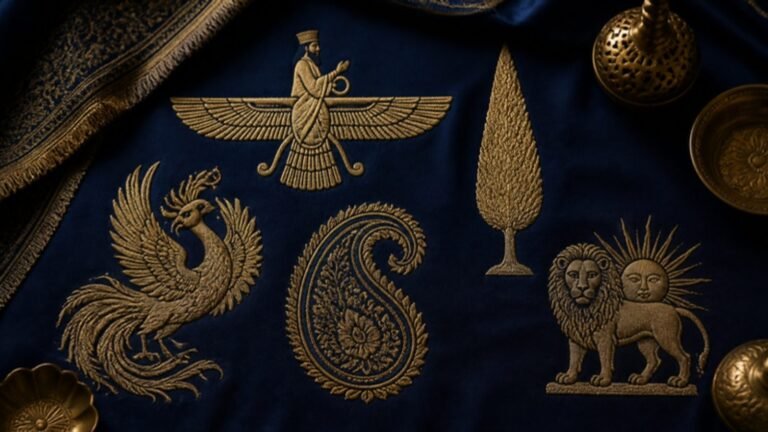
Today the Lion and Sun lives on in a new way. For Iranians in Los Angeles, Toronto, London, Berlin and beyond, it is a symbol of shared heritage that predates any modern government. You see it at cultural festivals, on jewelry and art, at Nowruz celebrations and on clothing. It sits naturally beside other ancient emblems such as the Faravahar and the Simurgh, which we describe in our guide to ancient Persian symbols.
What the Lion and Sun Represents
- The lion: courage, strength and protection.
- The sun: light, life, wisdom and the ancient Persian reverence for the sky.
- Together: a land that is both brave and full of light, and a culture that has endured for thousands of years.
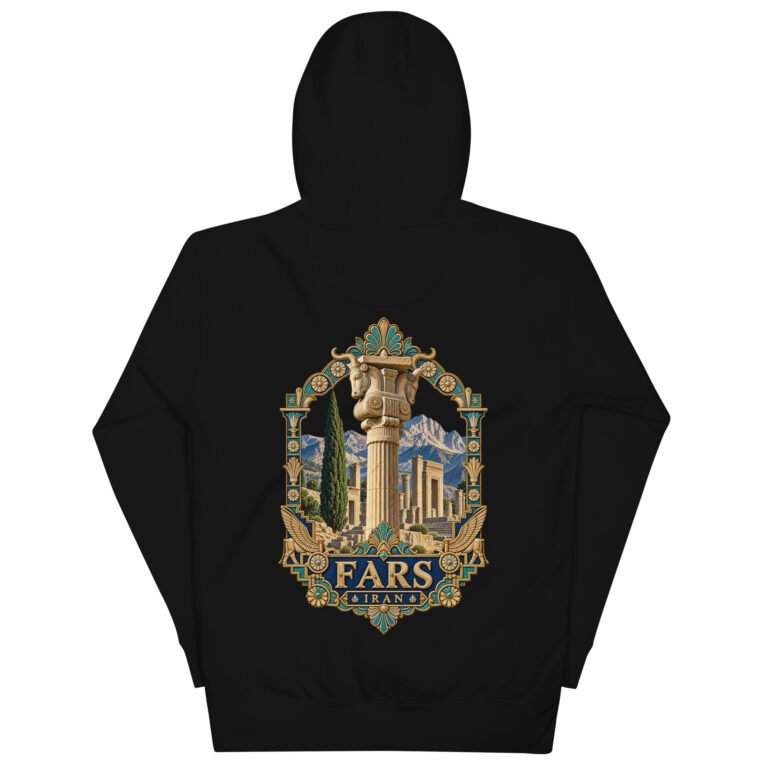
At Arya Roots, the same spirit of heritage shapes every design, from the Spirit of Iran collection to tees and hoodies for each of the 31 provinces of Iran.
Frequently Asked Questions
What does Shir-o-Khorshid mean?
Shir-o-Khorshid is Persian for “lion and sun.” It is the name of the emblem that shows a lion with the sun rising behind it.
How old is the Lion and Sun symbol?
The motif comes from ancient astrology, which linked the sun with the sign of Leo. Dated examples on coins go back to the 13th century, and the emblem became widespread in Persian art under the Safavids.
When was the Lion and Sun on Iran’s flag?
It appeared on Iranian flags from the early 19th century, was written into Iran’s constitutional laws in 1907 and remained the national emblem until 1979.
What was the Red Lion and Sun Society?
It was Iran’s national humanitarian society, founded in 1922 and part of the international Red Cross and Red Crescent Movement. Its Red Lion and Sun emblem was recognized by the Geneva Conventions in 1929.